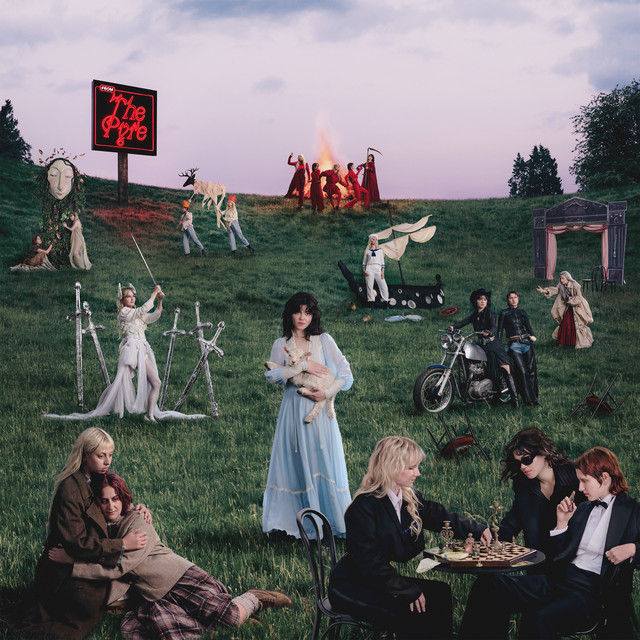
 otherworld official cover. Source: maddieashman.bandcamp
Maddie Ashman is a composer and songwriter from London. Specialising in microtonal music, she has recently set out on a musical journey to escape the twelve fixed notes typically used within Western music.
Microtonal guitars are designed to play intervals smaller than the standard semitone; they have two or three times the number of frets of a standard guitar, allowing for more melodic possibilities. The result is jarring to some, but when I came across a video of her playing on TikTok I was absolutely mesmerised.
Otherworld consists of five songs, and was released on Bandcamp in March. On her writing process, Ashman explains:
“I was thinking of questions like what if the guitar could sing? Or speak? What if the guitar could express beyond its traditional limits? What if the voice was the "instrument' rather than the guitar?”
The EP blends avant/psychedelic-folk with "freak-folk", often recalling the microtonality of King Gizzard in acoustic form. Paired with deeply poetic lyrics by Jessa Brown, it is a truly unique piece of music.
Ashman has detailed her struggle to find a label and thus release music through Spotify due to the eccentricity of her music. Not being readily accessible on Spotify made the EP just that bit harder to find, but I felt it was part of this otherworldly experience. As the title suggests, Brown’s lyrics enter another realm, using Welsh folklore and landscape as a backdrop for her grandmother Jennifer’s story. Ashman’s microtonal composition was perfect for such rich storytelling. Some quickly dismiss microtonal instruments as sounding badly out of tune, but Ashman proves otherwise. She translates Brown’s narrative of “half-memories and lost voices” onto her guitar, unlocking the instrument and the unspoken things within. When she plays, a language emerges.
Otherworld opens with 'horizon.' Shrill vocals urge the listener to "come and be free," inviting them into this eerie "otherworld." The way Ashman’s voice effortlessly jumps to different notes creates labyrinthine melodies. Narratively, 'horizon' is the start of Jennifer’s story and how the Welsh landscape calls out to her. 'moonlight' follows, an uneasy listen yet softened by Ashman’s enchanting harmonies. This track is representative of what microtonal guitar can do. It takes completely unexpected turns; you think you know where the song is going, then a singular note sticks out and changes the course of the song.
Next is 'dark,' my favourite off the EP. It is a dark, menacing song that works itself into a frenzy as we are fully immersed in the "otherworld." Ashman describes the song as "soft rap electronic music," switching between singing and spoken lyrics. She also uses a guitar slide to access unique chord voicings, and often makes the guitar sound percussive. The song emphasises the versatility of her voice, at times breathy and others piercing. It reminded me of The Cocteau Twins’ frontwoman Elisabeth Fraser, and her ability to make the voice an instrument in itself. Although Ashman’s lyrics are fully transcribed, she sings them in an almost indecipherable way until all that’s left is the melody. It perfectly echoes the narrator’s journey as she enters the wooded world that has long called out to her.
The fourth movement, 'blossom,' is a beautiful song written entirely in Welsh. It recounts Jennifer’s decision to relearn the language and reconnect with her landscape. The lyrics are heavily inspired by the Mabinogion character Blodeuwedd, a goddess made out of wild flowers. The guitar is minimal here, offering respite after ‘dark’ and making the microtonality stand out even more as Ashman fingerpicks mellow chords. The lyric "rwy'n blentyn eto (I am a child again)” compliments the cathartic quality of this otherworld and the belonging Jennifer feels there.
The final track, 'bonfire,' sees Jennifer trying to recover her past through the landscape. It places the guitar and vocals in conversation with each other. Ashman makes use of the "hocket" form, an interrupted effect used in medieval music; it is produced by dividing a melody between two parts, with the notes in one part coinciding with the rests in the others. The result is a chopped vocal style which makes it hard to believe it's just her and her guitar. The lyric "what if this green otherworld makes a woman of a girl" really stood out to me. In folklore, forests and green spaces often become places of transformation and discovery, and the EP really taps into this. It culminates in the nonsensical yet haunting line, "I am a return."
Otherworld is an EP that defies musical boundaries and embraces unconventionality. Ashman suggests that change is still possible within modern music, even if it remains peripheral and unrecognised. It’s unlike anything I’ve heard before, but I would recommend it to fans of experimental music with profound and mythical storytelling.
Otherworld is available and free to stream now on Bandcamp!